Computational biology

Emilio Venegas

Geometric deep learning for structure-based drug design, and longitudinal modeling of clinical cohorts.

B.Sc. Biosciences, Tecnológico de Monterrey, 2026
Guadalajara, Mexico
emiliovenegas10@gmail.com

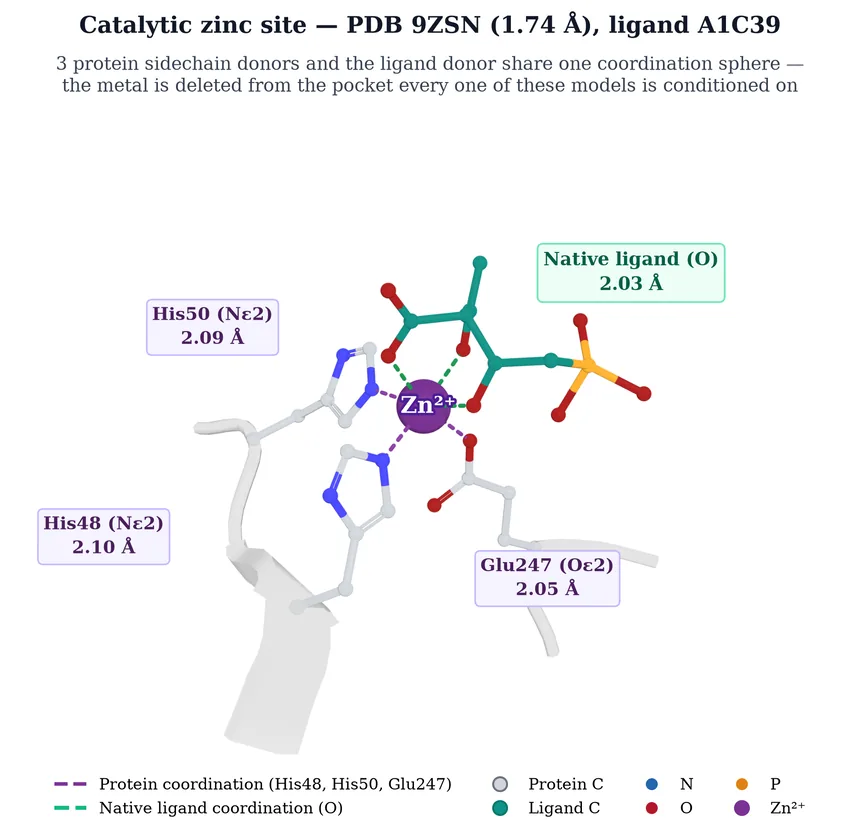
Catalytic zinc site of PDB 9ZSN at 1.74 ångström resolution. Three protein sidechain donors — His48 at 2.10 Å, His50 at 2.09 Å and Glu247 at 2.05 Å — share the zinc coordination sphere with one native ligand oxygen at 2.03 Å.
Catalytic zinc site, PDB 9ZSN (1.74 Å). Three protein sidechain donors and one native ligand donor share the coordination sphere. This is the atom that published generative models delete before they ever see the pocket.

Selected work

The metal is deleted before the model ever sees the pocket.

Published pocket-conditioned generative models strip catalytic metal ions during preprocessing, found by reading the source code. A pre-registered four-arm ablation tested candidate repairs. More metalloprotein training data worsened coordination rather than helping. A vocabulary-injecting LoRA adapter improved over the base model but fell short of the registered threshold. Hard-pinned seed inpainting shattered ligand connectivity. Both TargetDiff and Pocket2Mol replicate the failure under their own preprocessing. Manuscript in preparation.

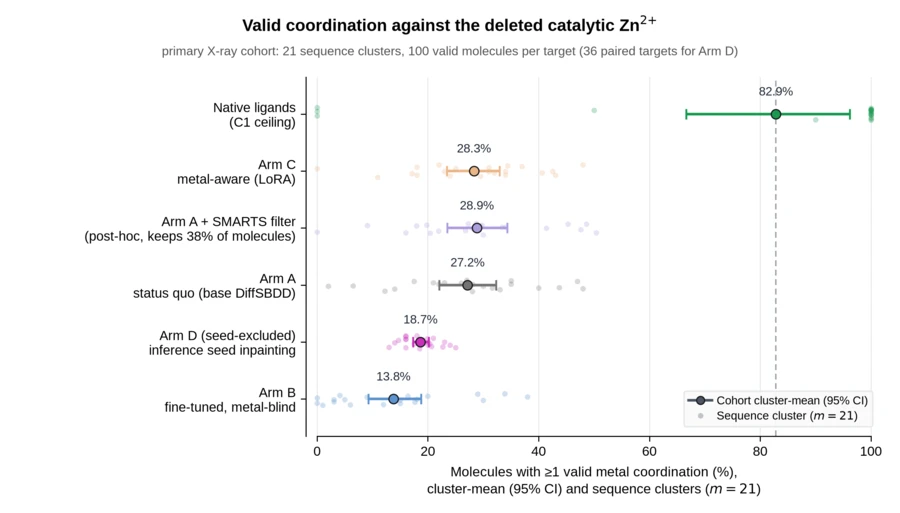
  • 82.9%native-ligand ceiling, cluster-mean
  • 20.0%base DiffSBDD, pooled
  • 24.1%metal-aware LoRA (Arm C), pooled
Dot-plot of valid zinc coordination rate for six series on the primary X-ray cohort. Each point is the cohort cluster-mean with a 95 percent confidence interval; faint dots show individual sequence cluster rates. Native ligands reach 82.9 percent. Arm C metal-aware LoRA and Arm A with post-hoc SMARTS filter cluster near 28 percent. Base DiffSBDD Arm A sits at 27.2 percent. Arm D seed-excluded inpainting reaches 18.7 percent. Metal-blind fine-tuned Arm B is lowest at 13.8 percent.
Valid coordination against the deleted catalytic Zn²⁺. Primary X-ray cohort: 21 sequence clusters, 100 valid molecules per target. Points are cohort cluster-means with 95% bootstrap CIs; background dots show individual cluster rates. Fine-tuning moves the wrong way; the metal-aware LoRA improves over baseline but stays well below the native ceiling.

Nucleic-acid thermodynamics without NUPACK or ViennaRNA.

Nearest-neighbor free energies, O(n³) secondary-structure folding by Zuker and McCaskill recursions, strand-displacement rate constants, and a defect-weighted parallel-tempered sequence designer — pure Python with an optional Rust fast path, and no external thermodynamics dependency. Validated against canonical hairpins rather than asserted. Published on PyPI as strider-dna.

  • 0.99mean F-measure, 11 canonical hairpins
  • 10/11exact structure match
  • 646tests passing
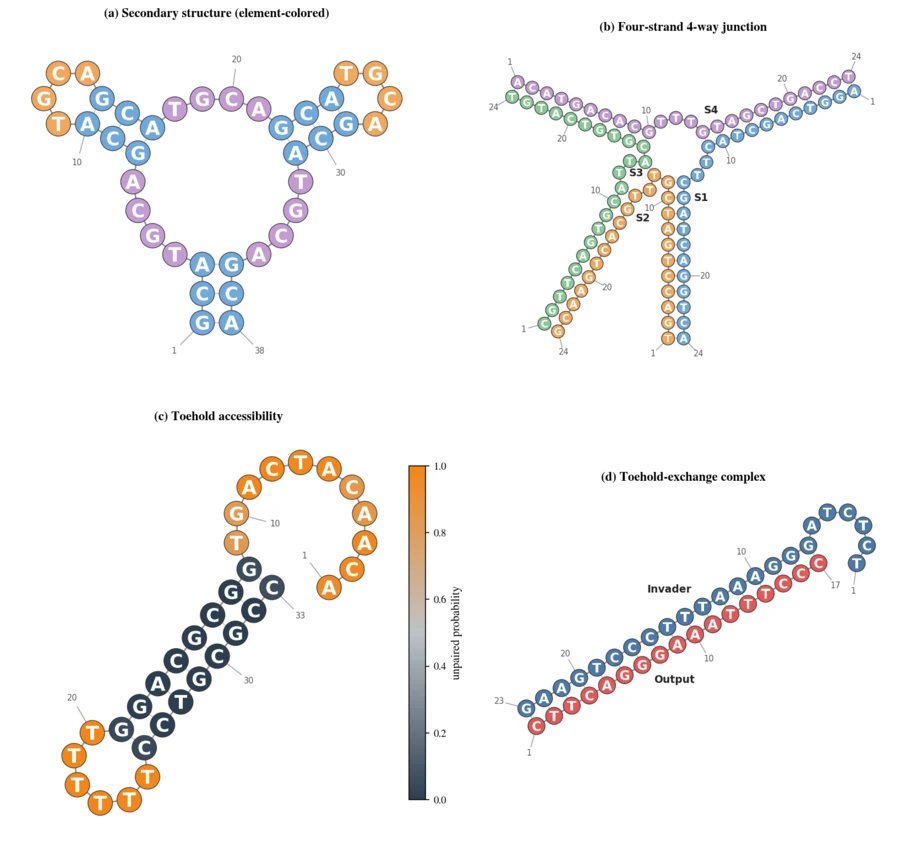
Four-panel figure of strider nucleic acid visualizations. Panel a: a 38-nucleotide secondary structure drawn with element-colored circles, showing a branched topology with two loops. Panel b: a four-strand 4-way junction with strands S1 through S4 fanning out from a central junction. Panel c: a toehold accessibility plot for the same structure, nucleotides colored from dark to orange by unpaired probability. Panel d: a toehold-exchange complex showing an invader strand displacing an output strand.
Nucleic acid structure visualization. Secondary structures, multi-strand junctions, base-pair accessibility, and toehold-exchange complexes — all rendered natively from strider's own energy model output.

Aging as a velocity, not a state.

A latent Neural ODE–VAE over six waves of the Mexican Health and Aging Study, 2001 to 2021, compressing 34 clinical deficits into an 8-dimensional manifold whose native output is aging velocity. Two patients with identical frailty scores can sit in entirely different velocity regimes. Cognitive-decline AUC 0.72 → 0.79 and functional-decline 0.67 → 0.75 over demographics and clinical state under patient-level 5-fold cross-validation. Mortality C-index reaches 0.865 on the velocity-extreme quartiles against 0.780 for the same encoder and risk head without ODE integration on the full cohort — different samples, so that gap is indicative and not a clean single-factor ablation. A digital-twin module re-integrates the learned dynamics under modified lifestyle controls, behind a conformal Mahalanobis out-of-distribution guardrail.

  • 0.865C-index, velocity extremes (n=11,366)
  • 0.780no ODE, full cohort (n=22,729)
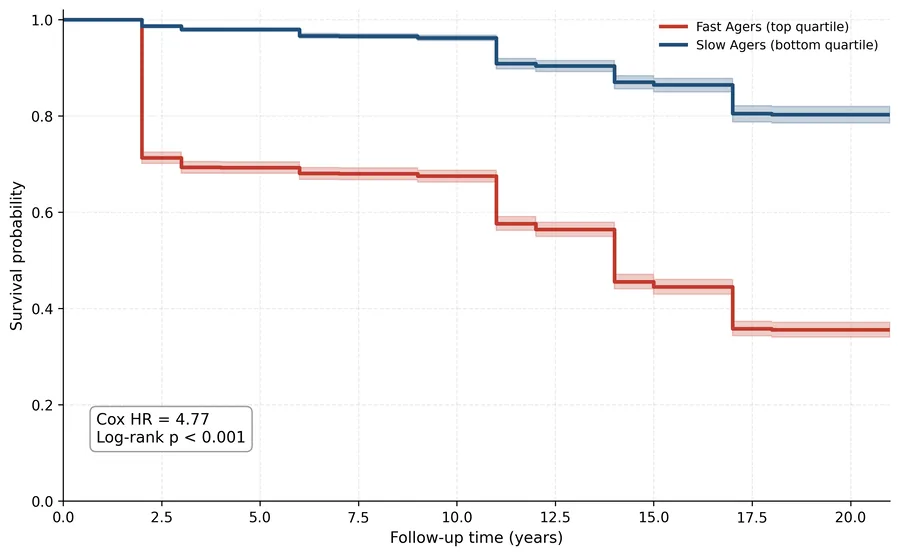
  • 4.77×mortality hazard, fast vs slow agers
Kaplan-Meier survival curves over twenty years of follow-up. Slow agers in the bottom velocity quartile stay near 0.8 survival probability, while fast agers in the top quartile fall below 0.4, annotated with a Cox hazard ratio of 4.77 and a log-rank p below 0.001.
Survival by velocity phenotype. Fast agers against slow agers over 20 years of follow-up, Cox HR 4.77 adjusted for baseline age and encoder uncertainty.

Does a pretrained interaction representation beat raw pocket geometry?

Couples frozen ATOMICA pocket embeddings — a foundation model pretrained on roughly two million molecular interaction interfaces — into a frozen DiffSBDD through a single SE(3)-equivariant cross-attention adapter. Both backbones stay frozen, so the measured effect isolates the conditioning signal. Drug-likeness rises, diversity falls. The honest reading is narrower than that sounds: preprocessing handed ATOMICA the whole pocket as a single UNK block, engaging none of its interaction semantics, so this stands as a clean negative result for naively-extracted foundation-model embeddings — and the matched docking comparison that would settle it has not been run. Motivated by PBP3 in multidrug-resistant A. baumannii, P. aeruginosa and K. pneumoniae; the benchmark reported here is CrossDocked.

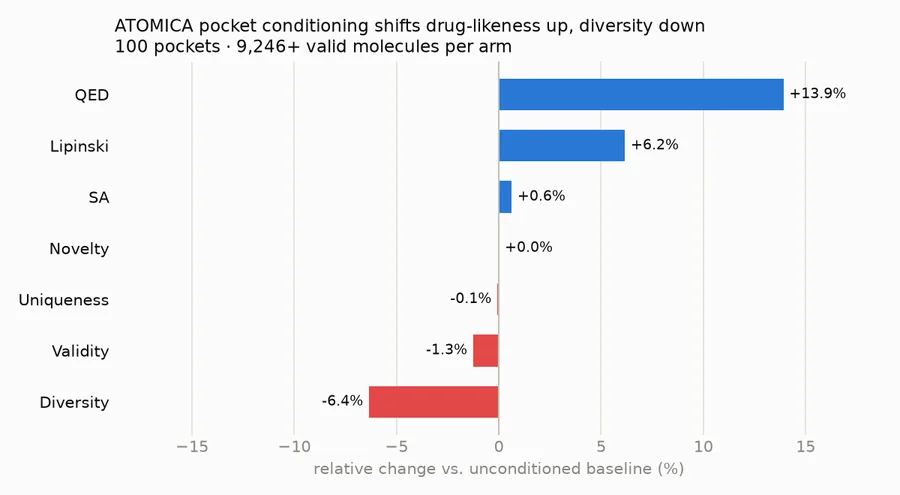
  • +13.9%QED against unconditioned baseline
  • +6.2%Lipinski compliance
  • −6.4%diversity, the tradeoff
Bar chart of relative change against the unconditioned baseline across 100 pockets. QED rises 13.9 percent and Lipinski 6.2 percent, synthetic accessibility 0.6 percent, novelty unchanged, while uniqueness falls 0.1 percent, validity 1.3 percent and diversity 6.4 percent.
A/B ablation, 100 held-out pockets, 9,246+ valid molecules per arm. Pocket conditioning shifts drug-likeness up and diversity down.

Certify the dynamics from topology, before running anything.

Chemical reaction network theory under mass-action kinetics: deficiency, linkage classes and weak reversibility, then the Deficiency Zero and Deficiency One theorems, with symbolic ODEs and Jacobians derived through SymPy. Where the Deficiency Zero Theorem applies you know the qualitative behaviour — one stable steady state, no oscillations, no bistability — for every physically admissible rate constant, without running a single simulation. The Deficiency One Theorem bounds how many steady states exist without excluding oscillation, and where no theorem applies the numerical side takes over and finds the limit cycles.

  • <1%deviation from QSSA, 400× activity scan
  • <10⁻⁶steady-state residual tolerance, M s⁻¹
  • 169tests passing
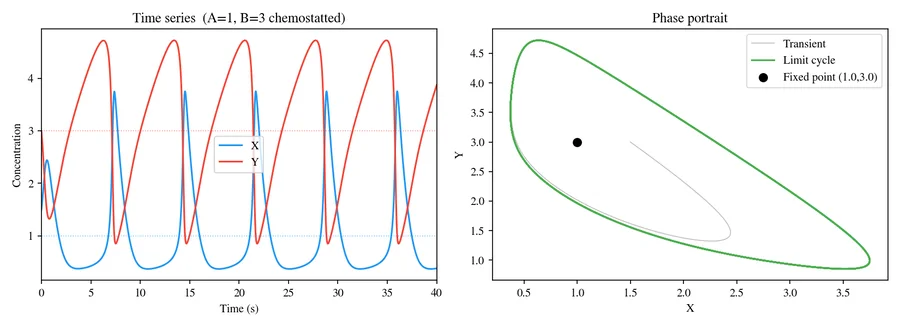
Two panels for the chemostatted Brusselator. The left panel shows about six cycles over forty seconds: species X spikes sharply while species Y rises slowly and collapses at each spike. The right panel shows the phase portrait, with the transient spiralling outward onto a closed limit cycle around a marked unstable fixed point.
Brusselator, A = 1 and B = 3. Relaxation oscillation and the limit cycle in phase space, with the unstable fixed point marked — this network is deficiency one and not weakly reversible, so no theorem rules the cycle out.
06

Gram-stain pathogen identification

not public

Whole-slide attention over a corpus built with the microbiologists who labelled it.

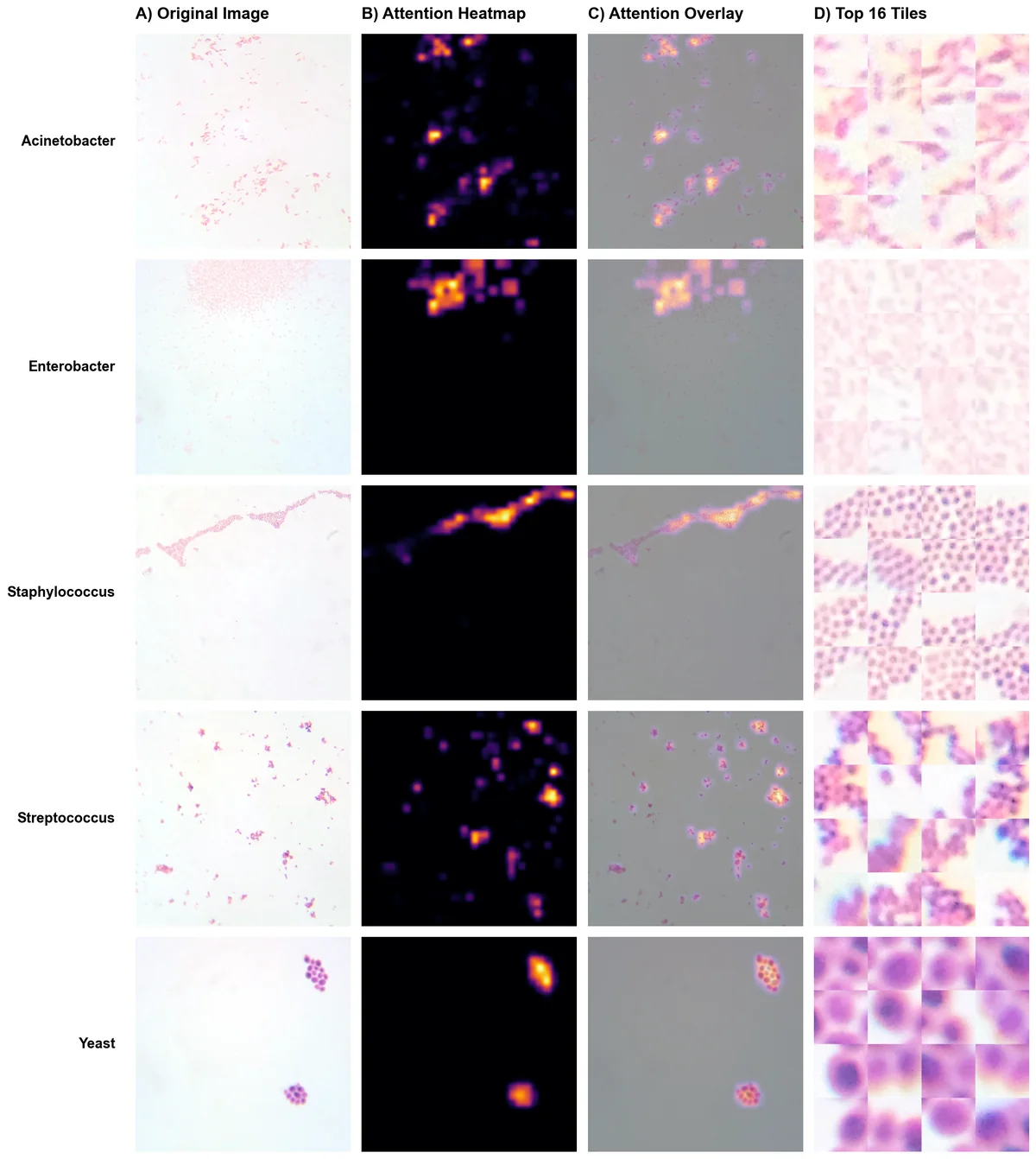
Self-attention Multiple Instance Learning over Vision Transformer patch embeddings, standardizing 5,828 clinical isolates through 95th-percentile normalization, CLAHE and Otsu thresholding, with multi-head attention modelling spatial context across the whole slide. Built with clinical microbiologists at Hospital Civil de Guadalajara, who set the label-quality and validation design. Manuscript under review and the code is not public, so unlike every other number here these three are self-reported.

  • 0.947accuracy, Gram class
  • 0.876accuracy, species level
  • 5,828clinical isolates
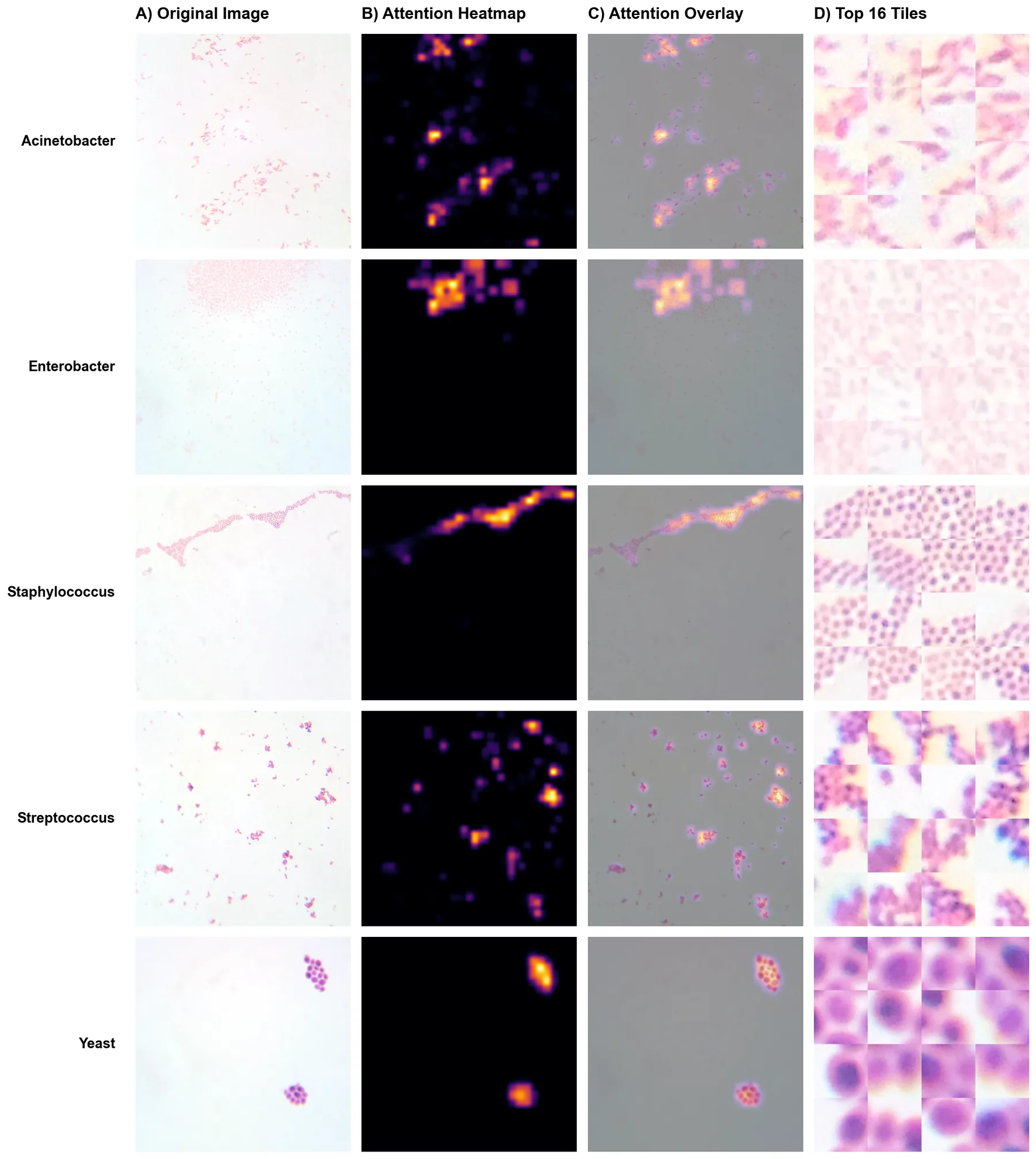
A four-column grid repeated for five classes — Acinetobacter, Enterobacter, Staphylococcus, Streptococcus and Yeast. Column A is the original Gram-stained micrograph, pink for Gram-negative rods and purple for Gram-positive cocci. Column B is the model's attention heatmap on black, where bright inferno-coloured peaks mark the tiles the model weighted most. Column C overlays that heatmap on the micrograph, showing the peaks landing on the stained organisms rather than on empty background. Column D shows the sixteen highest-attention tiles, each containing visible cells of the expected morphology.
Where the model looks, five representative classes. Attention concentrates on stained organisms rather than on slide background or debris. The Enterobacter row is the informative one: attention fires on a dense smear whose highest-weighted tiles are nearly featureless. Full size.

Also public: VAMprinting, a web controller for volumetric additive manufacturing printers · arq, LangGraph agents for molecular design over SMILES · CancerSense, a mammography CNN on INbreast and DDSM

Background

  • Education

    B.Sc. Biosciences, Tecnológico de Monterrey, 2026. A.Sc. Pharmaceutical Chemistry, CETI Colomos, 2022.

  • Previously

    Instrumentation and tomographic-printing software at Brigham and Women's Hospital / Harvard Medical School. Machine learning at Mendel Biosciences. AI/ML research at Hospital Civil de Guadalajara.

  • Bench

    Cell culture, 3D spheroids, qPCR, flow cytometry, Western blotting, organic synthesis. The Gram-stain corpus above was labelled in the same hospital lab that produced the slides.

  • Olympiad

    Gold Medal, Iberoamerican Chemistry Olympiad, 2021. Bronze Medal, 53rd International Chemistry Olympiad, Japan, 2021.